What must it do?
Define the work the mission application must support.
PUBLIC EXPLAINER & MISSION CATALOG · NOVEMBER 2026
90 mission examples. Six domains. One mission-first approach.
A mission expresses what people want achieved and sustained as conditions change. This document explains that distinction and gives each example a practical starting point: what the application must do, who holds authority, what must always hold and what it must observe.
Complete original 36-page PDF · No login required · 28.8 MB
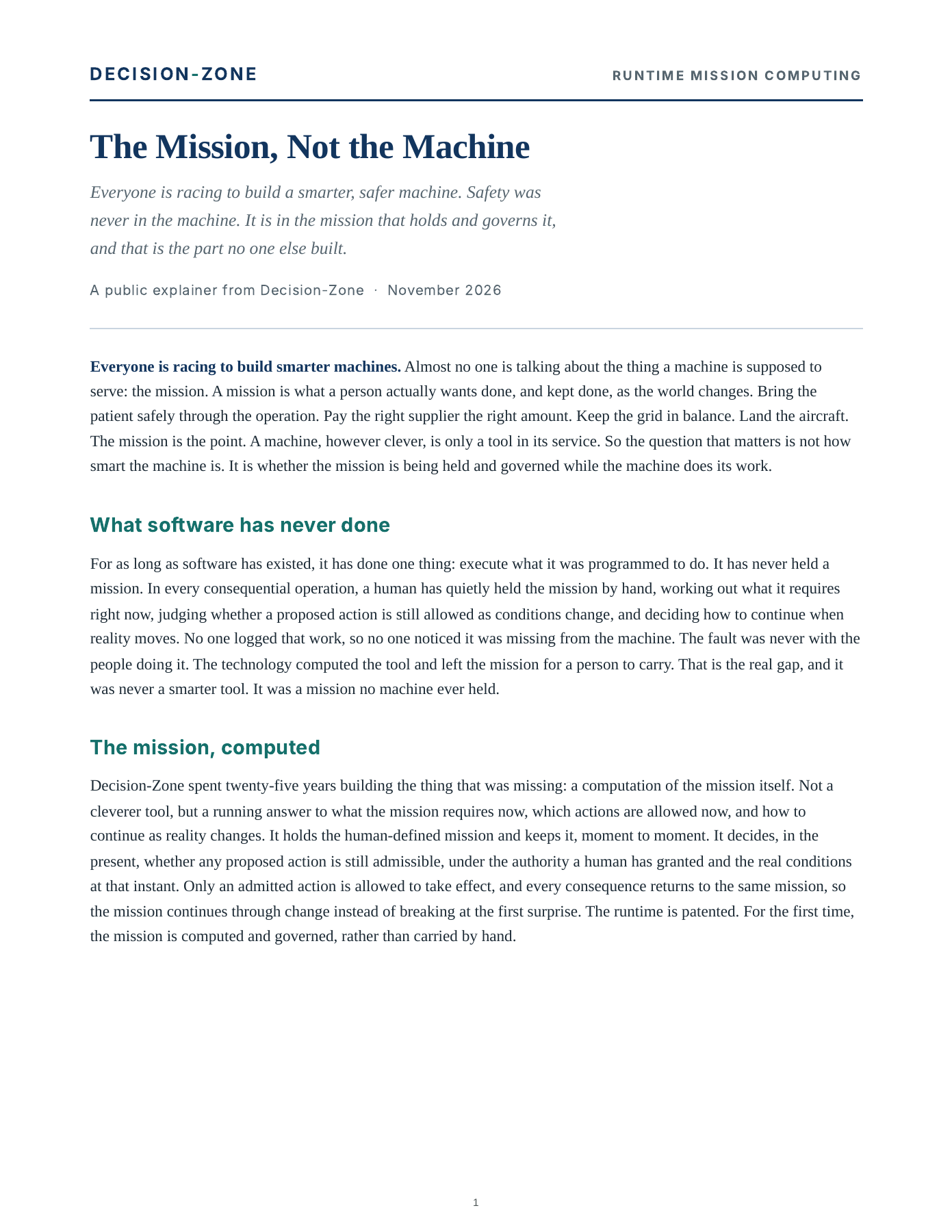 ACTUAL FIRST PAGE · READ ALL 36 PAGES
THE FOUR QUESTIONS, FOR ANY MISSION
Define the work the mission application must support.
State the human authority under which proposals may be admitted.
Define invariants, constraints and kinetics: limits, timing and rates.
Identify the data, events and capabilities the mission needs to connect to.
Human authority stays outside the runtime. The Persistent Requester computes what remains required; independent Actors propose possibilities; the Independent Governor determines proposal-specific admissibility. Requester and Governor are not Actors. Only an admitted proposal crosses the Commit Boundary, and observed consequences return to the same continuing mission.
THE MISSION CATALOG
Browse the six categories below. Each opens its section in the complete original PDF; your PDF viewer may handle page links differently.
Healthcare, payments, logistics, energy, education and the services people rely on.
Read this category PART 2 · 15 EXAMPLES · PAGES 13–16Study, skills, savings, teamwork and healthy routines under personal and family authority.
Read this category PART 3 · 15 EXAMPLES · PAGES 17–21Physical work in factories, hospitals, hazardous environments and space operations.
Read this category PART 4 · 15 EXAMPLES · PAGES 22–26Communications, Earth observation, constellation operations and missions beyond Earth.
Read this category PART 5 · 15 EXAMPLES · PAGES 27–31Public services, emergency response, infrastructure and national responsibilities under lawful authority.
Read this category PART 6 · 15 EXAMPLES · PAGES 32–36Pandemic response, energy, water, food security and continuity through major disruption.
Read this categoryThese are illustrative mission definitions, not a list of deployed applications, customer relationships or endorsements. Named organizations and platforms in the original document provide example contexts. Operational use requires the appropriate human approvals, integrations and domain validation.
Mission-level admissibility complements capable Actors and existing safety, alignment and cybersecurity measures; it does not require dismissing those safeguards. Economic figures in the original are illustrative, not quotations or guarantees. Public UMB portal access is coming soon.
For comfortable phone reading, use “Read the complete document” above to open the original PDF full-screen. Every page is preserved unchanged.
Explore Papers & Primers