SOFTWARE EXECUTES WHAT WAS DECIDED EARLIER. THE PRESENT IS STILL COMPUTED BY A PERSON.
The architectural paper distinguishes the familiar execution environment from present-tense mission computation. Programs, models and operating structures carry out what was established earlier. When reality changes, a person has historically supplied the continuing computation of what is required and what is admissible.
Decision-Zone Runtime Computing makes those responsibilities computationally explicit and independent. Triadic Causal Programming keeps the mission’s requirement, Actor possibilities and proposal-specific admissibility present against live causal reality. Mission Autonomy is the operational result.
THE ARCHITECTURAL DISTINCTION
RUNTIME EXECUTION vs RUNTIME COMPUTING
EXISTING TECHNOLOGY
RUNTIME EXECUTION
PRESCRIPT
Executes what was decided earlier.
Software, AI models and agentic Actors execute or generate behavior using previously established programs, models, objectives and operating structures.
Human operational computationRequirement & admissibility
Software · AI · agentic ActorsExecute / generate behavior
Changed conditions return to the human
HUMAN INSIDE THE MACHINE LOOP
Humans continue to supply mission-level requirement and admissibility computations when conditions change.
The paper distinguishes an execution environment—a process, container or inference server—from the continuing computation of a mission’s remaining requirement. Running a prescribed response continuously does not, in this framing, supply an independent Requester or Governor.
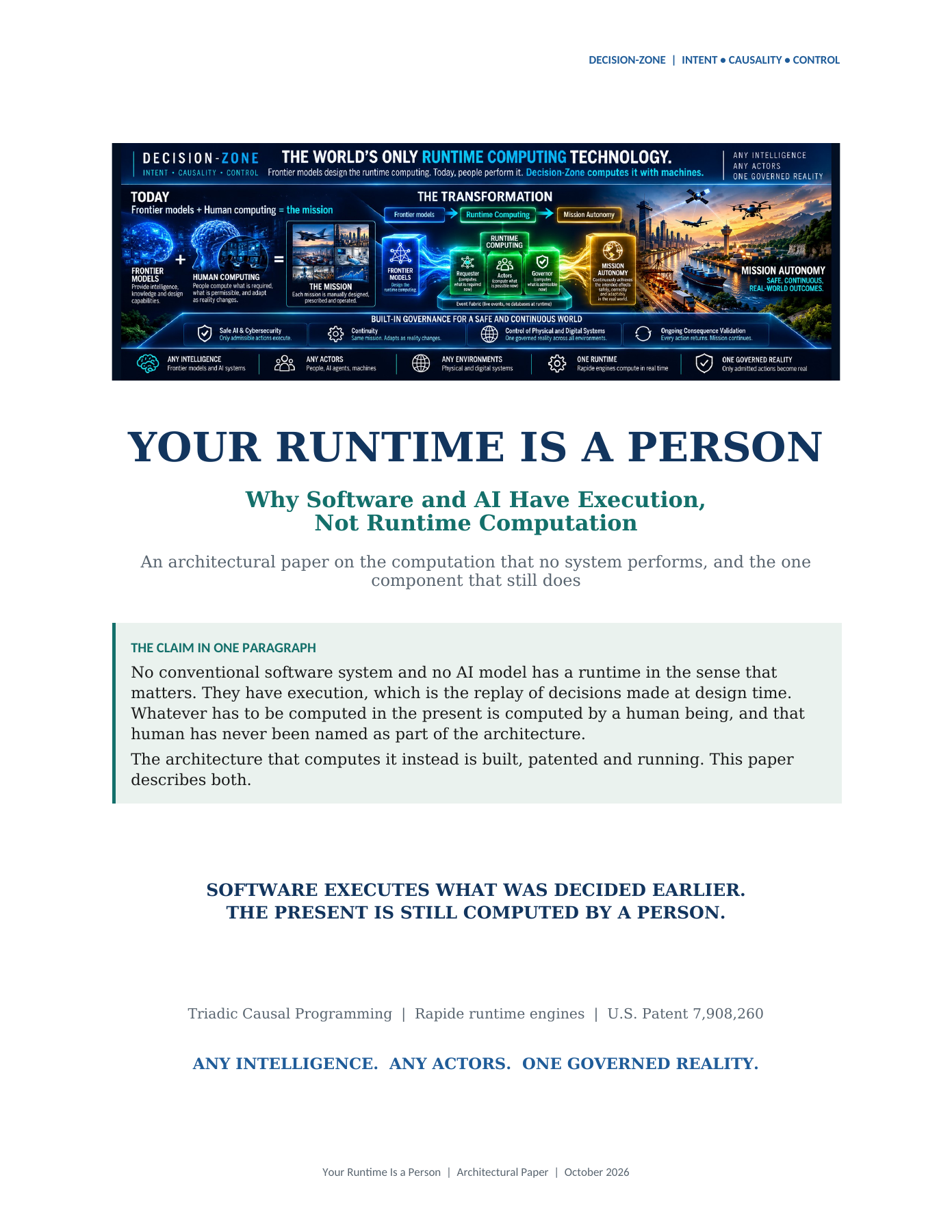
DECISION-ZONE
RUNTIME COMPUTING
TRIADIC CAUSAL PROGRAMMING
Computes what is required, possible and admissible now.
Three independent runtime computations operate against live causal reality.
Persistent RequesterWhat is required now?
Independent ActorsWhat is possible now?
Independent GovernorWhat is admissible now?
LIVE CAUSAL EVENT FABRIC · CURRENT CAUSAL STATE
COMMIT BOUNDARYOnly admitted actions execute
Observed consequence → same continuing mission
MACHINE INSIDE THE HUMAN-DEFINED MISSION
Only admitted actions cross the Commit Boundary. Observed consequences return to the same continuing mission.
Human beings define mission intent, authority and boundaries. The runtime independently computes the continuing mission within those declared boundaries. Neither the Requester nor the Governor is an Actor; an Actor’s capability cannot create authority to commit.
THE PROGRAMMING ARCHITECTURE
TRIADIC CAUSAL PROGRAMMING
Three independent computations. One human-defined mission. Live causal reality.
What is required now?
Persistent Requester
Computes what the human-defined mission requires now, what has been fulfilled and what effect remains required as reality changes.
Requester is not an Actor.
What is possible now?
Independent Actors
Compute possible realizations using identified capabilities and provenance. Actors have no authority to commit their own proposals.
Possibility is not governing authority.
What is admissible now?
Independent Governor
Computes proposal-specific admissibility now under represented human authority, invariants, constraints, kinetics and current causal reality.
Governor is not an Actor.
Humans define mission intent, authority and boundaries. They are not an operational component of the autonomous runtime triad.
HUMAN AUTHORITY · MISSION AUTONOMY
HUMAN CENTRICITY
From a human inside the machine’s loop to the machine inside the human’s mission.
THE TWO HUMAN LAYERS TODAY
Programming the system. Computing its operation.
Conventional systems depend on two layers of human work: programming behavior in advance, and continuing operational computation when reality changes. Operators observe, decide, intervene and recover where prescribed behavior cannot determine what the mission now requires.
Human involvement in that operational loop is not the same as human authority over it.
THE HUMAN DEFINES THE MISSION
Purpose and authority remain human.
The Human Mission Owner declares the mission’s required effect, authority, invariants and constraints. Frontier models support design-time compilation into an executable Triadic Causal Programming package.
At runtime, machines independently compute what the mission requires, what is possible and what is admissible against live causal reality. The person remains the source of what the system is for and the authority under which it may act.
We are not automating people out. We are taking them out of the loop and putting them in charge of it.
Authority is not delegated to the Actor.
The Persistent Requester and Independent Governor are distinct runtime computations, not AI Actors. No Actor authorizes its own proposal, and no frontier model supplies the Governor’s runtime determination.
The Rapide engines compute against live causal reality. Only admitted actions cross the Commit Boundary. Observed consequences return to the same continuing mission, which computes the remaining required effect again.
Companion publication · October 2026 · 3 pages. The complete original PDF is preserved independently of the 14-page architectural paper.
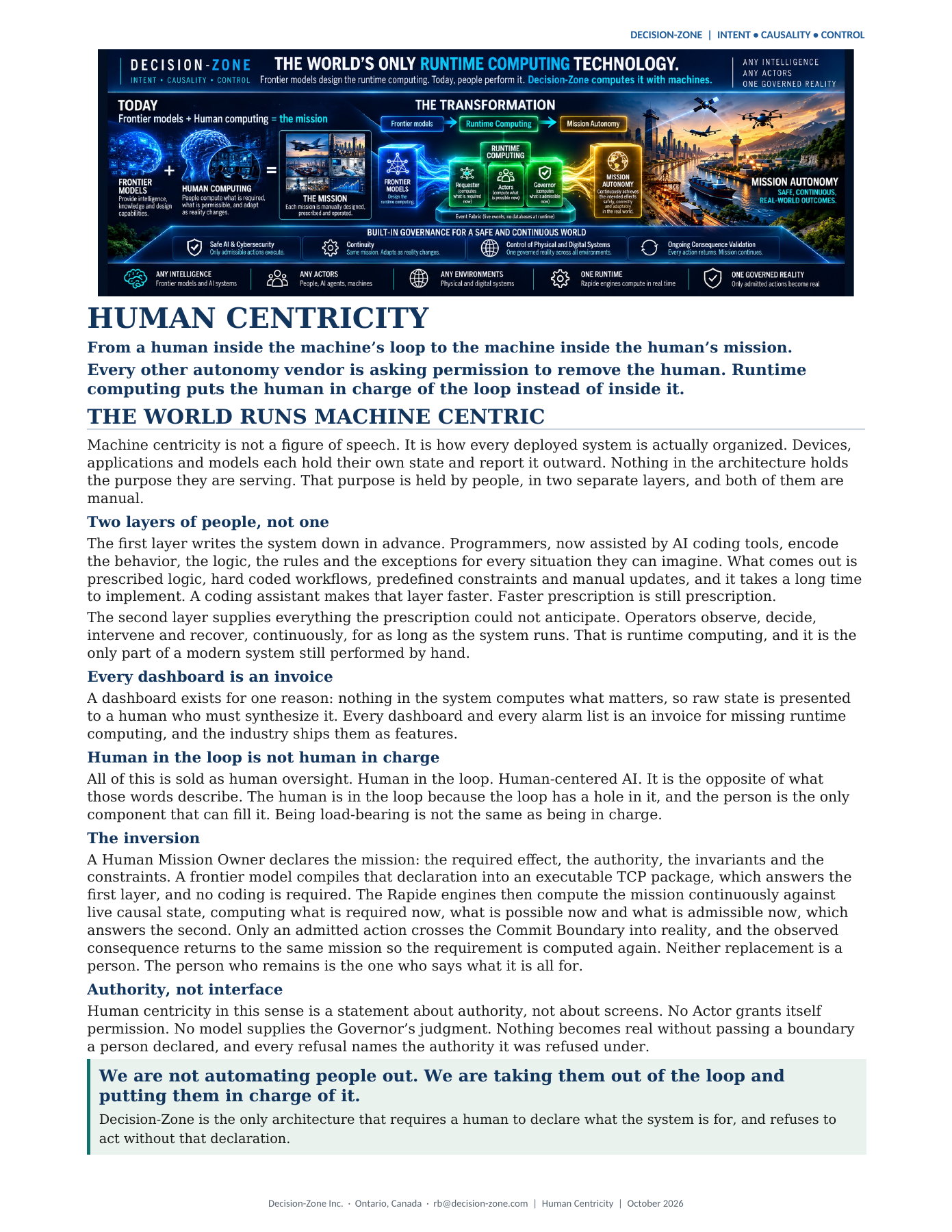
ORIGINAL ARCHITECTURAL GRAPHIC · PAGE 2
From the machine’s loop to the human’s mission
The Human Mission Owner declares the mission, authority, invariants and constraints. Frontier models support design-time compilation. At runtime, the Persistent Requester and Independent Governor are distinct computations, not AI Actors. Independent Actors propose possible realizations; only admitted actions cross the Commit Boundary.
The Rapide engines compute continuously against live causal reality. The live causal Event Fabric returns observed consequences to the same mission, which recomputes fulfillment and the remaining requirement. The same architecture is shown across application domains without merging Requester, Actors or Governor.
THE LIVE RUNTIME ARCHITECTURE
THE SAME MISSION COMPUTES AGAIN.
LIVE CAUSAL EVENT FABRICSystem events · sensor events · Actor proposals · observed consequencesLive events construct and evolve in-memory causal state, supporting runtime computation.
01
Human-Defined Mission
Declared intent, authority and boundaries
02
Persistent Requester
Computes the current required effect
03
Independent Actor Proposals
Identified possibility and provenance
04
Independent Governor Determination
Proposal-specific admissibility
05
Commit Boundary
Only admitted actions cross
06
Execution
A bound capability acts
07
Observed Consequence
What actually changed returns as events
08
Same Persistent Mission
Mission identity and causal continuity remain
09
Recomputed Remaining Requirement
The same mission computes what is required next
Observed consequences return to the same continuing mission.Fulfillment, recovery and the remaining required effect are recomputed against changed causal reality.
This sequence illustrates causal relationships, not a hard-coded workflow or a prescribed sequence of behaviors.
IMPLEMENTED TECHNOLOGY
THE PROGRAMMING MODEL AND THE RUNTIME.
Triadic Causal Programming
The patent-pending programming model declares the mission’s independent computations, authority and boundaries. It is distinct from the technology covered by the granted runtime patent.
Rapide runtime engines
Live causal event construction, validation and execution provide the runtime causal technology described in the paper. The corrected granted patent reference is U.S. Patent 7,908,160, “System and method for producing audit trails”—distinct from the patent-pending Triadic Causal Programming model. The original publication is preserved unchanged; this corrects its printed patent-number typo.
Live causal Event Fabric
System, sensor, proposal and consequence events continuously construct and evolve in-memory causal state. Runtime computations operate against that current causal reality.
Admissibility before commitment
The Independent Governor computes a determination for the specific proposal. Actors cannot authorize their own actions. Only admitted actions cross the Commit Boundary.
Consequence return
Execution changes the world. Observed consequences return as events to the same continuing mission, which recomputes fulfillment, recovery and the remaining required effect.
Human-defined authority
Human beings define and approve mission intent, authority and boundaries. The autonomous runtime triad does not insert an operational human, a supervisory AI Actor or a second model as its Governor.
Why Software and AI Have Execution, Not Runtime Computation
Conventional software executes decisions established earlier. Humans have historically supplied the continuing computation of mission requirements and admissibility as reality changes.
This paper explains that missing runtime computation and presents Decision-Zone’s implemented architecture: Triadic Causal Programming, independent Requester, Actor and Governor computations, Rapide runtime engines, live causal Event Fabric, Commit Boundary and consequence return.
Synthetic executable demonstrations. They are not production Rapide deployments, operational aircraft, real vehicles, live clinical systems or physical facility integrations.